

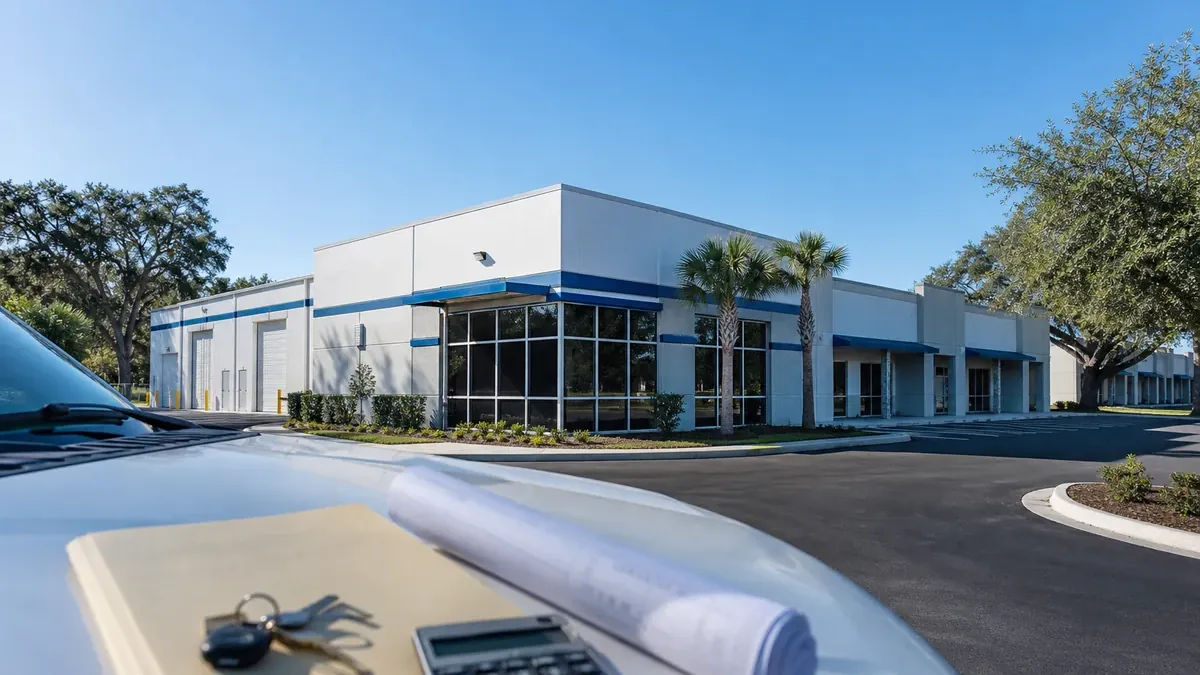
The first question I get on almost every commercial call around Ocala isn’t about the rate. It’s how much do I need down? And the honest answer is a number with a footnote, because on a commercial loan your down payment isn’t set by a rule. It’s set by the building.
Here’s the whole picture, with the footnotes filled in.
The short answer: on a true commercial property in Ocala, plan on 25% down, because most programs on our platform lend up to 75% of value. A one-to-four unit rental on a DSCR investor loan runs 20–25%. Short-term rental and PadSplit programs reach 80% loan-to-value, so 20%. Then add 2–5% for closing costs and several months of payments in reserves, and understand that the property’s income can push the down payment above every one of those figures.
Down payment by lane: what the programs actually allow
Different deals live in different programs, and each program has its own ceiling. These are the current guidelines on the Coast2Coast commercial and investor platform as of this writing. Guidelines move, so treat the table as “most programs, today” and the priced scenario as the real answer.
| Deal type | Typical max LTV | Down payment | What else drives it |
|---|---|---|---|
| True commercial — office, retail, warehouse, 5+ unit apartments, self-storage, mixed-use | Up to 75% | 25% | Net operating income must cover the payment at ~1.25x |
| DSCR rental — 1–4 units, long-term tenants | 75–80% | 20–25% | Rent ÷ payment from 1.0x; credit from 620; LLC allowed |
| Short-term rental — Airbnb/VRBO, 1–4 units | Up to 80% on purchase | 20% | AirDNA projection or 12 months of booking history; credit from 640 |
| PadSplit / co-living — room-by-room | 80% purchase, 75% refi | 20% | Converted floor plan has to be read by someone who knows construction |
| Foreign national — no U.S. credit | 60–75% | 25–40% | International credit references, translated financials |
| Owner-user with an SBA 504 structure | Bank 50% + CDC 40% | ~10% | Business occupies the majority of the building; runs through a bank and a CDC, not every lender |
Two things jump out of that table. First, the DSCR and short-term rental lanes are cheaper to get into than true commercial, which is why I spend part of every first call making sure a deal is in the right lane before anyone talks about money. A duplex off Maricamp Road is a 20–25% DSCR deal, not a 25%-plus commercial one. Second, the 10% SBA row is real but narrow: it’s for the business owner buying the building they operate from, and it’s a different closing process with its own timeline. If your deal fits it, I’ll tell you so.
The number that quietly changes your down payment: the income test
Here’s the part the brochures skip. Loan-to-value is a ceiling, not a promise. Before a commercial lender gives you 75% of the price, the property has to prove it can pay for that much debt. The test is debt service coverage: net operating income divided by the annual mortgage payment, and most commercial programs want 1.25x or better.
When the income supports less debt than the LTV cap allows, the loan shrinks, and every dollar it shrinks by becomes your down payment. I walked through the full underwrite in how lenders size a commercial real estate loan in Ocala, but let me show you the collision with real numbers.
A worked example: a $1.2M flex warehouse off SR 200
Say you’ve found a small flex building on the SR 200 corridor at $1,200,000, two tenants in place, netting $96,000 a year after taxes, insurance, maintenance and a vacancy allowance. Every figure below is illustrative, not a quote, and rounded to keep the math readable.
The LTV math says: 75% of $1.2M is a $900,000 loan, so $300,000 down.
The income math says something else. At 1.25x coverage, the most debt service the building supports is $96,000 ÷ 1.25 = $76,800 a year, or $6,400 a month. Work that payment backward at an illustrative 7.5% on a 25-year amortization and the loan it supports is roughly $866,000.
The smaller number wins. Your loan is about $866,000, not $900,000, and your down payment just moved from $300,000 to roughly $334,000, call it 28%. Nothing about your credit or your bank balance changed. The building’s income set the number.
| Cash to close (illustrative) | Amount |
|---|---|
| Down payment (income-sized loan, ~28%) | $334,000 |
| Closing costs at ~3% — appraisal, lender fees, title, survey, reports | ~$36,000 |
| Reserves — 6 months of the ~$6,400 payment | ~$38,400 |
| Total liquidity the file needs to show | ~$408,000 |
That’s the conversation I’d rather have on a phone call than on an appraisal invoice. A buyer who walks in planning on $300,000 and learns about $408,000 at the underwriting desk has a problem. A buyer who knows the real number before writing the offer can negotiate price, ask for a seller credit, or restructure. Which brings us to the next question.
Where the down payment can come from
Commercial and investor programs source every dollar, and they are less forgiving than home loans about where it came from.
- Your own liquid funds, seasoned in your accounts. Statements get read line by line, and large recent deposits get questioned.
- Proceeds from a sale, including a 1031 exchange. Exchange funds are common on investor deals around Ocala, and the timeline rules on the exchange side are strict, so tell me early.
- Cash-out from property you already own. A refinance on a paid-down rental, or a commercial cash-out on a building you hold, is a legitimate equity source. Sequencing matters: that loan has to close before this one.
- A partner’s documented equity. Fine, as long as the operating agreement says what it says and the partner’s money is sourced too.
- A seller-held second mortgage. Sometimes allowed, usually with a combined loan-to-value cap and a lender’s blessing. It can bridge a gap; it can also kill a deal if it surfaces late.
- Gift funds — the workhorse of first-time home buying — are generally not accepted here. Plan without them.
Reserves and closing costs: the two numbers everyone underestimates
Closing costs on a commercial purchase run heavier than a home closing, commonly 2–5% of the price, and the biggest single line is usually the appraisal. A commercial appraisal is a narrative report on income, comparables and market, often several thousand dollars and several weeks, versus a few hundred for a house. Add a survey, title, lender and processing fees, and depending on the property an environmental screen or a property-condition assessment. On a warehouse or auto-service property, that environmental report isn’t optional.
Reserves are the liquid money still in your accounts after you’ve written every check at closing. Most programs want to see a cushion of several months of the full payment, and they want more when the property has vacancy, a lease rolling in year one, or a renovation plan. The reserve requirement is also where a cash-tight buyer learns that putting more down to hit a ratio can backfire: you solved coverage and starved reserves.
Construction and value-add deals are measured differently
If your Ocala deal involves building or renovating — a vacant retail box on Silver Springs Boulevard that needs a new roof and a reconfigured floor plan, a horse-country parcel with a development plan, a self-storage expansion — the down payment conversation changes shape. Lenders size those on loan-to-cost and the finished value, not the purchase price. Your equity is measured against the whole budget: land, hard costs, soft costs, interest carry and a contingency. And the lender wants your equity in the deal first, before the first draw is funded.
This is home turf for me. I spent twenty years building and defending construction budgets as a project manager before I started originating loans, and the value-add files that go sideways almost always have the same flaw: a thin contingency and a draw schedule nobody stress-tested. Bring me the budget and the contractor package and I’ll tell you whether the equity number holds, before an underwriter does. The renovation and construction programs on the loan menu run parallel to the commercial lane, and some deals fit better there.
Where this leaves you
The down payment on a commercial loan in Ocala is 25% until the building says otherwise, and the building usually has an opinion. Run the income test before you fall in love with the price, source your funds before you write the offer, and budget closing costs and reserves as real line items instead of rounding errors.
If you’re circling a property anywhere in Marion County — a strip center, a warehouse, a four-unit, a parcel with a plan — send me the price, the property type, and the income if it has any. I’ll size the loan the way the underwriter will and give you the real cash-to-close number before you’re committed. No credit pull for the conversation. Direct line, seven days a week.